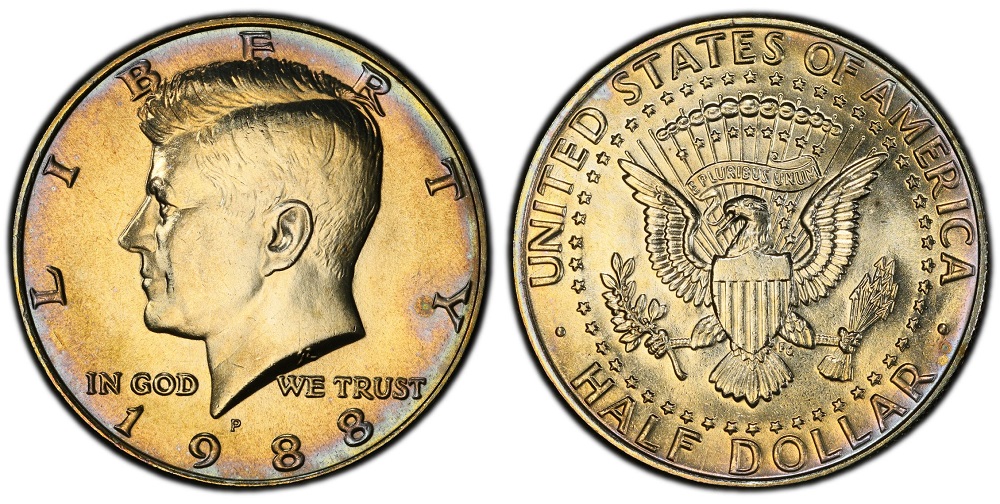
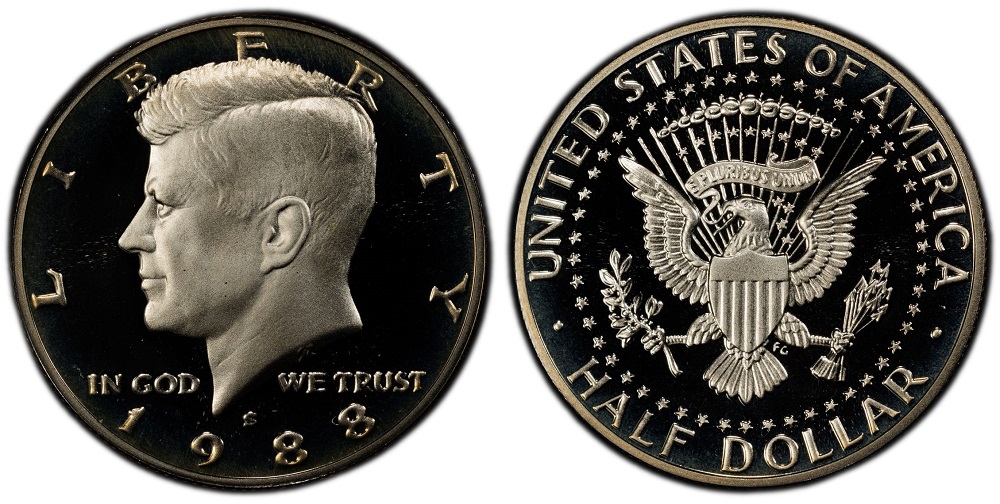
1988 Half Dollar Value: From Face Value to $3,680

A perfect 1988-S proof sold for $3,680 at Heritage Auctions. Yet most 1988 Kennedy half dollars in change-jar condition are worth only 60 cents. The difference is mint mark, grade, and — for proof coins — knowing whether you hold the rare DDO FS-101 doubled die variety worth up to $1,150. This free calculator and guide will tell you exactly where your coin lands.

★★★★★ 4.8 · 1,347 collectors rated this tool
Check My 1988 Half Dollar Value →
1988 Kennedy half dollar obverse and reverse showing mint mark location and design details
$3,680 Top Auction Record (1988-S PR70 DCAM, Heritage 2003)
28.9M Total 1988 Half Dollars Minted (P + D + S)
~23 1988-S DDO FS-101 Examples Certified (PCGS, all grades)
1 of 1 1988-D MS-68 Known (Population Report, PCGS)

1988 Half Dollar Value Chart at a Glance

The table below summarizes market values across all three 1988 Kennedy half dollar varieties and all condition grades. For a more thorough illustrated breakdown of every grade tier, refer to this complete 1988 half dollar identification walkthrough covering strike diagnostics, mint mark positions, and high-resolution photos for each grade. Rows are based on PCGS and NGC price guide data as of early 2026.

Variety Worn / Circulated Uncirculated (MS-65) Gem (MS-67 / PR-69) Top Grade
1988-P (Philadelphia) $0.60 – $1.00 $12 – $20 $200 MS-68: ~$1,900
1988-D (Denver) $0.60 – $1.00 $12 – $20 $90 – $200 MS-68: $4,500 (pop. 1)
1988-S DCAM Proof N/A (proof only) $13 – $22 (PR-68) $16 – $55 (PR-69/70) PR-70 DCAM: $3,680
1988-S DDO FS-101 N/A (proof only) $225 (PR-67) $902 – $1,150 (PR-68/69) Rarest known variety

🟡 Gold row = signature variety (1988-S DCAM Proof). 🔴 Red row = rarest variety (DDO FS-101).

📱 CoinKnow lets you snap a photo and instantly estimate your 1988 half dollar's grade on the go — a coin identifier and value app.

Navigate This Guide

Jump to any section using the links below.

The Valuable 1988 Kennedy Half Dollar Errors — Complete Guide

Not every 1988 half dollar is worth face value. The varieties below represent the documented errors and die varieties that command real collector premiums — from a certified doubled die worth more than $1,000 to dramatic mint mishaps that make each example a singular collectible. Study each entry carefully: your coin's fortune may hinge on a single detail visible under a loupe.

MOST FAMOUS

1988-S DDO FS-101 (Doubled Die Obverse)

$225 – $1,150+ 1988-S DDO FS-101 doubled die obverse showing doubling on LIBERTY and IN GOD WE TRUST lettering under magnification
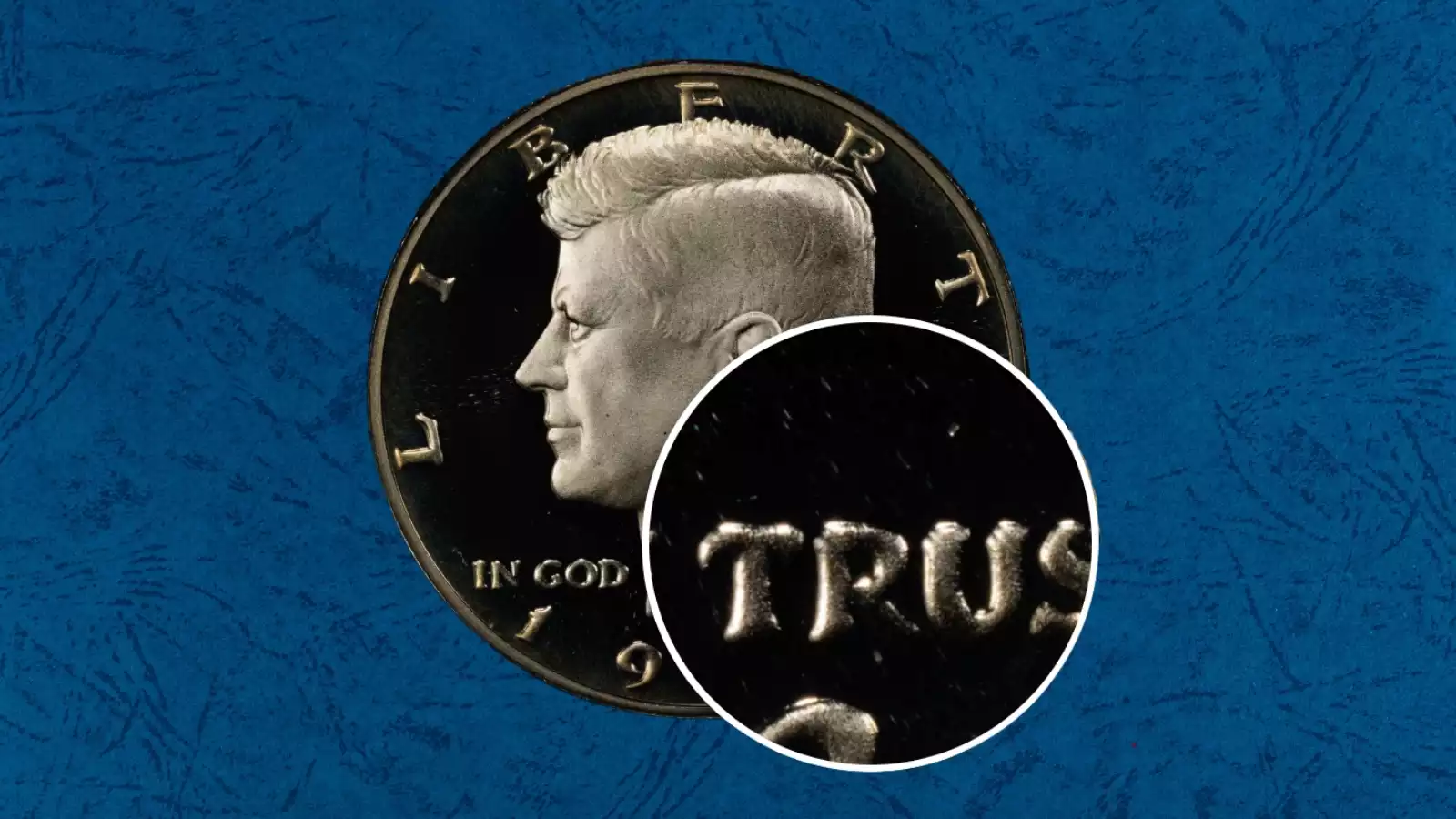
The 1988-S DDO FS-101 is the only widely attributed, fully certified die variety in the entire 1988 Kennedy half dollar series. It originated at the San Francisco Mint's proof die preparation facility when a working die received misaligned hub impressions during the hubbing process — two or more squeezes at slightly different angles left every design element offset on that die.

The resulting doubling is most visible on the obverse lettering LIBERTY and IN GOD WE TRUST, and on details of Kennedy's portrait. Genuine hub doubling produces thick, rounded, clearly separated letter impressions that are distinctly different from the flat, shelf-like shadows of the far more common machine doubling. This variety is catalogued as CONECA DDO-001 and is listed as FS-101 in the Cherrypickers' Guide to Rare Die Varieties.

With fewer than 25 total PCGS-certified examples across all grades, this variety is legitimately rare. Because proof dies handle far fewer coins than business-strike dies, the total population of coins struck from this die was always small — making survival count extremely low. Registry set collectors and variety specialists compete directly for available examples, supporting strong and consistent auction prices.

How to spot it

Use a 10× loupe and examine LIBERTY and IN GOD WE TRUST under raking light. Genuine hub doubling shows thick, rounded, separated letter impressions — not the flat machine-doubling shelf visible with naked-eye light.

Mint mark

S (San Francisco) — proof coins only; no equivalent business-strike version exists for 1988.

Notable

PCGS population: 2 in PR-67, 10 in PR-68, 11 in PR-69. A PR-68 specimen sold for $902 at Great Collections in September 2014 (PCGS #148737). CONECA attribution DDO-001 / FS-101.

DRAMATIC STRIKE ERROR

1988 Off-Center Strike Error

$30 – $200+ 1988 Kennedy half dollar with off-center strike error showing partial design impression and exposed blank planchet area
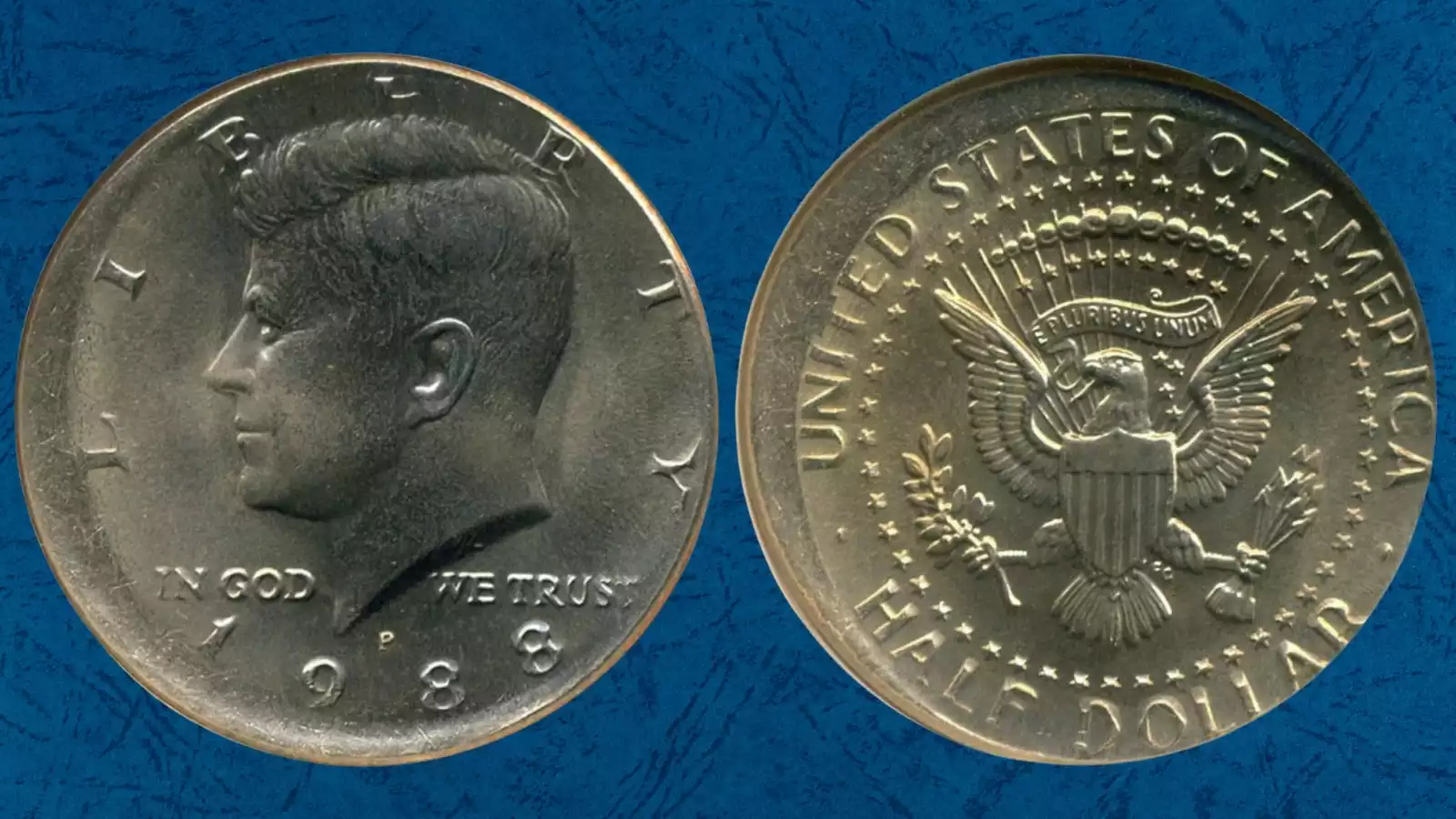
An off-center strike occurs when the planchet is not properly centered between the dies at the moment of striking. The press still delivers full tonnage, but the design only partially registers on the coin's surface, leaving a crescent of blank planchet metal exposed. The more severe the misalignment, the more dramatic — and valuable — the resulting error.

On a 1988 Kennedy half dollar, off-center errors are identifiable by a curved blank area on either the obverse or reverse, with the design elements skewed to one side. The most desirable examples show 25% to 50% off-center misalignment while still retaining a fully legible date — collectors specifically seek coins where "1988" remains readable despite the dramatic shift. Coins lacking a visible date are worth considerably less.

Off-center strikes are one-of-a-kind errors; no two are exactly alike. Value rises sharply with the degree of off-center shift and the clarity of the date. A mildly off-center example (5–10%) may bring only $30–$50, while a dramatic 30–50% off-center example with full date can command $100–$200 or more depending on overall surface quality and certification.

How to spot it

Hold the coin and look for a curved blank area along one edge — the design will appear pushed to the opposite side. Measure the blank crescent as a percentage of the coin's diameter using a millimeter ruler.

Mint mark

P (Philadelphia) or D (Denver) business strikes; off-center proof errors are extremely uncommon and would carry even higher premiums.

Notable

Off-center Kennedy halves with 25%+ shift and a visible date routinely bring $75–$200 at major auction houses. A rotated-die pair of 1988 coins (P + D, MS-64) realized $180 at auction, demonstrating strong demand for 1988 strike errors.

BEST KEPT SECRET

1988 Double Clip & Broadstruck Error

$150 – $400 1988 Kennedy half dollar double clip and broadstrike error showing two curved planchet clips and expanded design spread from missing collar
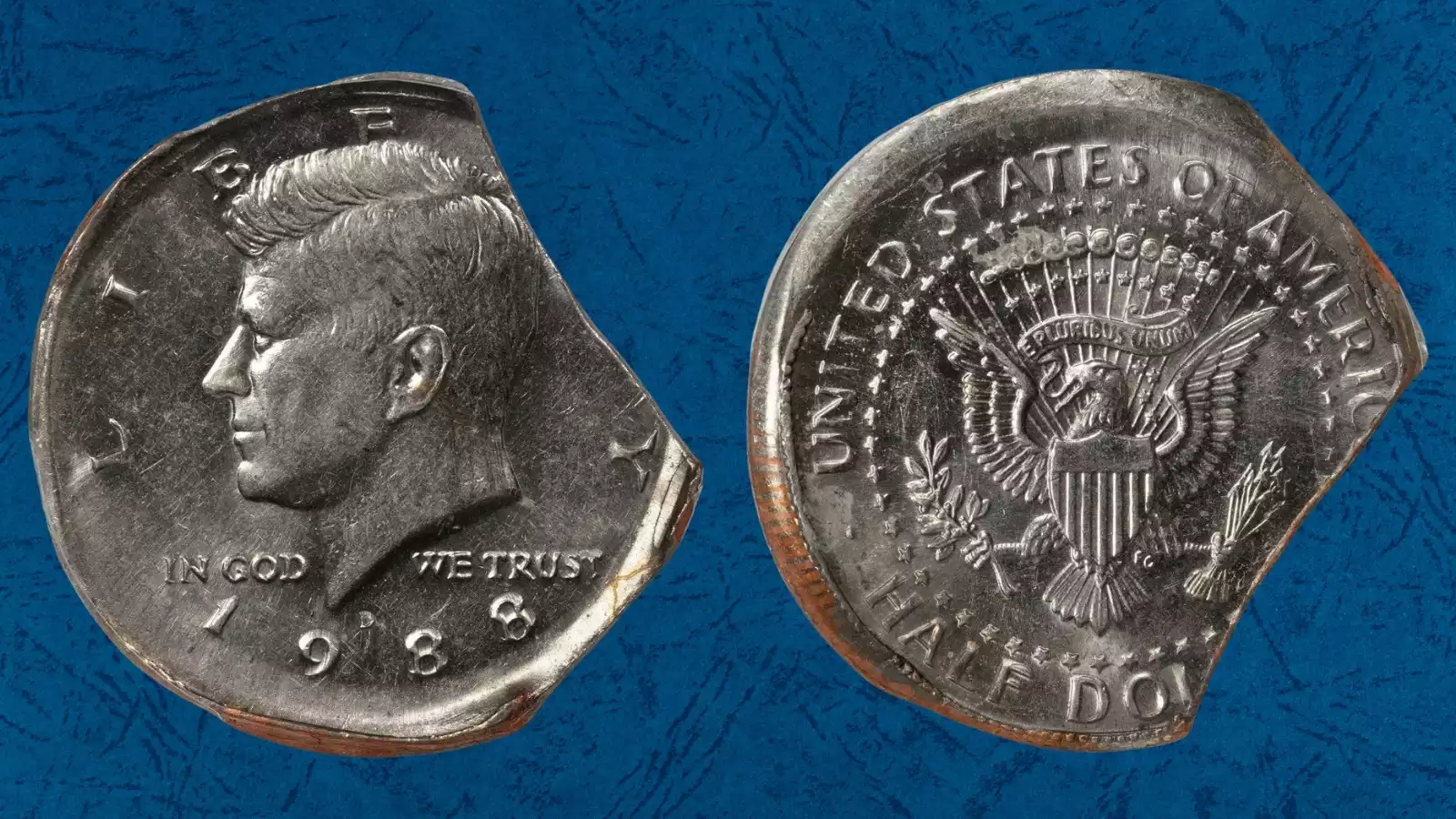
This dramatic combination error involves two separate defects occurring on the same coin. The double clip originates at the blanking stage, when the strip of metal passes over a previously punched-out hole — the blanking die "bites" into the gap, producing a curved cutout on the coin's edge. When this happens twice, two curved sections are missing, giving the coin a distinctive crescent-edged profile.

The broadstrike component occurs separately: when the retaining collar that constrains the planchet during striking is absent or fails to engage properly, the coin expands outward under the press's force. The result is a coin that is slightly larger in diameter and thinner than a normal specimen, with the design elements flowing toward the edges more than on a standard coin. Together, these defects create a doubly abnormal piece that is far rarer than either error alone.

A documented PCGS-graded AU-58 example of a 1988 double clip plus broadstruck Kennedy half dollar confirms this combination has been certified and traded. The combination nature drives value well above what either error would command independently. Specialists in mint error coins prize these multi-error pieces for their educational and display value in type collections.

How to spot it

Examine the coin's edge with a loupe for two distinct curved cutouts. Lay the coin on a flat surface — if it rocks slightly or appears non-round, the broadstrike has expanded the planchet. Opposite each clip, look for the diagnostic Blakesley effect (weak strike area).

Mint mark

D (Denver) documented example; P (Philadelphia) examples of single-clip broadstruck errors also exist for this year.

Notable

A PCGS-certified AU-58 example of this specific combination has been documented in the collector market. Values for comparable multi-error Kennedy halves from this era typically range from $150 to $400 depending on severity and grade.

RAREST STRIKE TYPE

1988 Rotated Die Error

$75 – $180+ 1988 Kennedy half dollar rotated die error showing the reverse eagle design significantly rotated from normal coin alignment
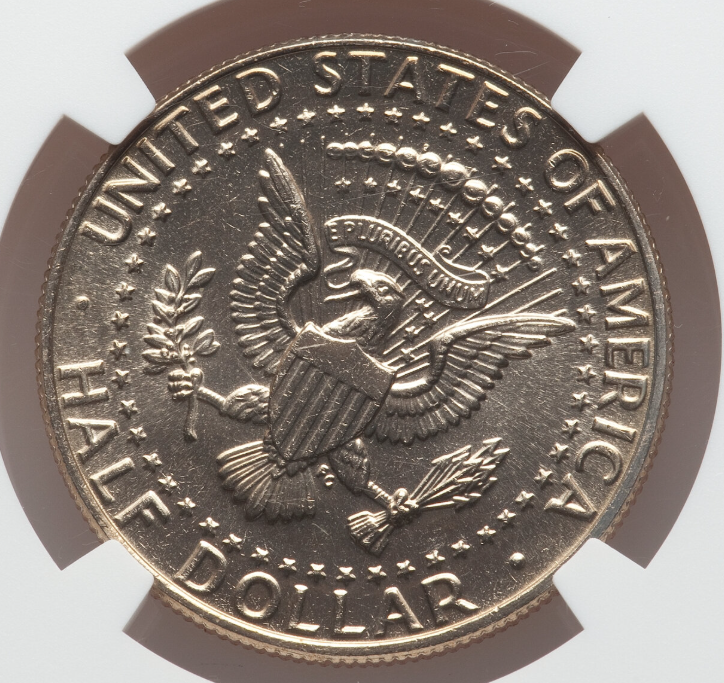
In a properly struck U.S. coin, the obverse and reverse designs are oriented 180 degrees apart — called coin alignment. When a die rotates out of its normal fixed position before striking, the resulting coin shows the reverse design at an unexpected angle relative to the obverse. A 90-degree rotation is sometimes called a "medallic alignment" error, while a full 180-degree rotation produces a coin where both sides are upright when flipped on a vertical axis.

On 1988 Kennedy half dollars, rotated die errors range from minor (less than 30 degrees, adding little value) to dramatic 90–180 degree rotations that are immediately obvious when the coin is flipped. The error is confirmed by holding the coin by the top and bottom of the obverse, then flipping it on its vertical axis — if Kennedy's portrait is upright on one side and the eagle appears sideways or upside-down on the other, the die was rotated. Larger rotations are rarer and more valuable.

Documented auction evidence confirms collector interest in this error type for the 1988 date. A rotated-die pair of 1988 Kennedy half dollars — one Philadelphia, one Denver, both graded MS-64 — realized $180 at auction, and individual examples with 180-degree rotation have sold for over $150. The error affects any die that becomes loose in its socket, making it a legitimate minting anomaly rather than post-mint damage.
How to spot it

Hold the coin upright by the obverse design. Flip it on its vertical axis (left to right). If the reverse eagle is not approximately upside-down (standard coin alignment), the die was rotated — measure the angle of deviation in degrees using a protractor app.

Mint mark

P (Philadelphia) and D (Denver) both documented; a paired P + D rotated error set realized $180 at auction, confirming both mints produced affected dies.

Notable

A 180-degree rotation example sold for over $150 individually. A GreatCollections auction listing documents a 1988-P with rotated dies graded NGC MS-65, confirming third-party authentication of this error type on the 1988 date.

Think you've spotted one of these errors on your coin? Run the free calculator to get an instant value estimate.

Get My Value Estimate →

1988 Kennedy Half Dollar Mintage & Survival Data

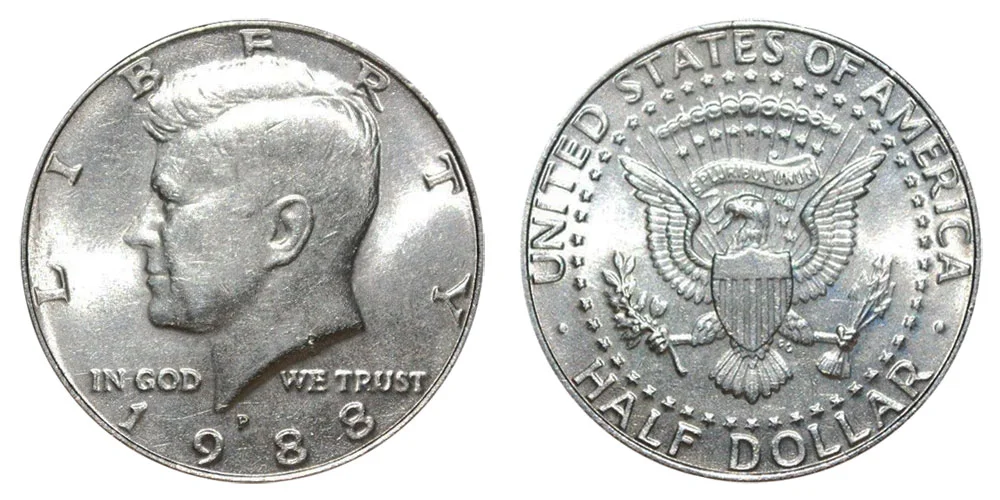
1988 Kennedy half dollar mint set packaging showing original Philadelphia and Denver mint coins in protective holders
Mint Mint Mark Strike Type Mintage Est. Surviving Survival Rate
Philadelphia P Business Strike 13,626,000 ~4,769,000 ~35%
Denver D Business Strike 12,000,096 ~4,200,000 ~35%
San Francisco S Proof (DCAM) 3,262,948 ~2,789,000 ~85%
Total 28,888,044 ~11,758,000
Composition specs: All 1988 Kennedy half dollars are copper-nickel clad — a pure copper core bonded with an outer layer of 75% copper / 25% nickel, for a combined average composition of approximately 91.67% copper and 8.33% nickel. Weight: 11.30–11.34 grams. Diameter: 30.61 mm. Edge: reeded (150 reeds). Designer: Gilroy Roberts (obverse) / Frank Gasparro (reverse). Melt value: approximately $0.13–$0.17 depending on copper price.

How to Grade Your 1988 Kennedy Half Dollar

Grading strip showing four 1988 Kennedy half dollars across four condition tiers from worn to gem uncirculated

Worn (G–VF)

Kennedy's cheekbone and hair above the ear are flattened. The eagle's breast feathers are merged into a smooth surface. Date and lettering remain readable. Most circulated examples grade here. Worth $0.60–$1.00 regardless of mint.

Circulated (EF–AU-58)

Slight rub on Kennedy's highest cheekbone and the eagle's breast feathers, but most detail is sharp. Hair strands partially intact. Under 5× magnification you can see where luster has been disturbed. Worth $0.75–$1.50. Certification not warranted at this grade.

Uncirculated (MS-60–MS-65)

Full original luster present with no trace of wear. Contact marks (bag marks) visible to the naked eye on Kennedy's cheek or the eagle's shield. Hair strand separation is complete. Worth $5–$20 depending on mark severity and strike quality.

Gem (MS-66–MS-67+)

Only tiny, scattered marks invisible without magnification. Full, sharp strike with complete hair detail and separated breast feathers. MS-67 requires near-perfection — only ~200 PCGS-certified 1988-D coins reach this tier. Worth $40–$200+ and warrants certification.

Pro tip — Strike vs. Luster: For 1988 business strikes, weak strikes (showing soft hair above Kennedy's ear and mushy eagle feathers) are very common due to worn dies and inconsistent 1980s production pressure. A coin with strong luster but a weak strike is capped below MS-66. Always inspect the hair detail above the ear and the eagle's central breast feathers first — these high-relief zones reveal strike quality before any other area.

🔎 CoinKnow lets you photograph your coin and compare it against graded examples to quickly match the right condition tier — a coin identifier and value app.

1988-S DDO FS-101 Self-Checker: Is Your Proof Coin the Rare Variety?

The 1988-S DDO FS-101 is the single most searched and most valuable variety in the 1988 Kennedy half dollar series. With fewer than 25 PCGS-certified examples, the odds are long — but the checklist below gives you the best DIY diagnostic before spending money on professional authentication.

Side-by-side comparison of normal 1988-S proof half dollar versus 1988-S DDO FS-101 showing hub doubling on LIBERTY inscription

🔵 Normal 1988-S Proof

  • Single, crisp letter impressions on LIBERTY and IN GOD WE TRUST
  • Letter edges are sharp and clean with no secondary offset images
  • Kennedy's portrait details sharp but singular
  • Worth $10–$55 depending on DCAM designation and grade

🏆 1988-S DDO FS-101 (Rare)

  • Thick, rounded doubled impressions visible on LIBERTY letters under 10×
  • IN GOD WE TRUST shows secondary offset impressions alongside primary letters
  • Doubling may also appear on Kennedy's portrait features
  • Worth $225–$1,150 — possibly more at competitive auction

Checklist: Does Your 1988-S Show These Characteristics?

Got a result from the self-checker? Now run the full calculator for a dollar value estimate.

Calculate My Coin's Worth →

Free 1988 Half Dollar Value Calculator

Select your mint mark, condition, and any errors below for an instant value estimate based on PCGS and Heritage auction data.

Step 1 — Select Mint Mark
Step 2 — Select Condition
Step 3 — Select Any Errors (Optional)

If you're not yet sure of your coin's mint mark or condition, there's a free 1988 Half Dollar Coin Value Checker tool that walks you through the identification process step by step using coin photos.

Describe Your 1988 Half Dollar for a Detailed Assessment

Not sure how to grade it? Describe what you see and our keyword analyzer will give you a tailored assessment.

Mention these things if you can

  • Mint mark: P, D, or S
  • Proof or business strike?
  • Hair detail above Kennedy's ear
  • Eagle feather sharpness on reverse
  • Any visible doubling in lettering
  • Mirror-like fields or frosted devices?

Also helpful

  • Bag marks or contact scratches?
  • Luster: bright, toned, or dull?
  • Edge: normal reeding or irregular?
  • Any curved blank area on coin?
  • Coin from a mint set or circulation?
  • Deep mirror fields with frosted design?

Where to Sell Your Valuable 1988 Half Dollar

The right venue depends on your coin's grade and variety. A raw circulated example belongs in a coin shop; a certified MS-67 or DDO FS-101 belongs at a major auction house.

🏛️ Heritage Auctions

The best venue for certified MS-67+, MS-68, and the 1988-S DDO FS-101 variety. Heritage's established collector base ensures competitive bidding for genuine condition rarities and key varieties. The $480 record for 1988-P MS-67 and the $3,680 record for 1988-S PR70 DCAM were both set here. Submit through their consignment team — minimum thresholds apply.

🛒 eBay / Online Marketplaces

Ideal for MS-65 to MS-66 business strikes and circulated examples. Check recently sold prices for 1988-P Kennedy half dollars on eBay to set a competitive asking price. Always list with clear, high-resolution photos of both sides. PCGS- or NGC-certified coins sell faster and command higher prices than raw examples.

🏪 Local Coin Shop

Best for quick, no-hassle sales of circulated examples and common-grade uncirculated coins worth $5–$40. Dealers typically offer 50–70% of retail value. Bring the coin in its original mint set packaging if available — this helps establish provenance. Get quotes from at least two shops before selling.

💬 Reddit r/Coins & Coin Forums

The r/CoinSales and r/Coins communities are good for networking with knowledgeable collectors who appreciate variety coins. Particularly useful for getting feedback on whether your coin shows genuine hub doubling before spending money on professional grading. Post clear loupe-quality photos for the best advice.

Get it graded first — for the right coins: PCGS or NGC certification is worth the $30–$50 fee only for coins that appear to grade MS-67 or higher (business strikes) or PR-70 DCAM (proofs), or for any coin showing characteristics consistent with the DDO FS-101 variety. A certified coin commands significantly more at auction and sells far more easily online. For circulated examples worth $1–$5, skip certification — fees exceed potential gain.

Frequently Asked Questions — 1988 Half Dollar Value

What is a 1988 half dollar worth?

A circulated 1988-P or 1988-D Kennedy half dollar is worth $0.60–$1.00, close to face value. Uncirculated examples in MS-65 grade fetch $12–$20. MS-67 business strikes command $90–$200, while the top-tier 1988-D MS-68 (population of 1 at PCGS) is valued at approximately $4,500. The 1988-S proof in PR70 DCAM holds the overall auction record at $3,680 (Heritage Auctions, 2003).

Is the 1988 half dollar rare?

The 1988-P and 1988-D business strikes are not rare in lower grades — millions were minted. However, they are condition rarities. The 1988-P mintage of 13,626,000 is notably low compared to most Kennedy half dollars from 1964–2001. Finding either date in MS-67 or higher is genuinely difficult, and gems command significant premiums. The 1988-S DDO FS-101 variety is extremely rare with fewer than 25 examples certified by PCGS.

What is the 1988-S DDO FS-101 error and what is it worth?

The 1988-S DDO FS-101 is a Doubled Die Obverse variety catalogued by CONECA and listed in the Cherrypickers' Guide. The working die received misaligned hub impressions, creating visible doubling on LIBERTY, IN GOD WE TRUST, and Kennedy's portrait details. PCGS has certified only about 23 examples across all grades. Values range from approximately $225 in PR-67 to $1,150 in PR-69, with a PR-68 specimen realizing $902 at Great Collections in 2014.

How do I find the mint mark on a 1988 half dollar?

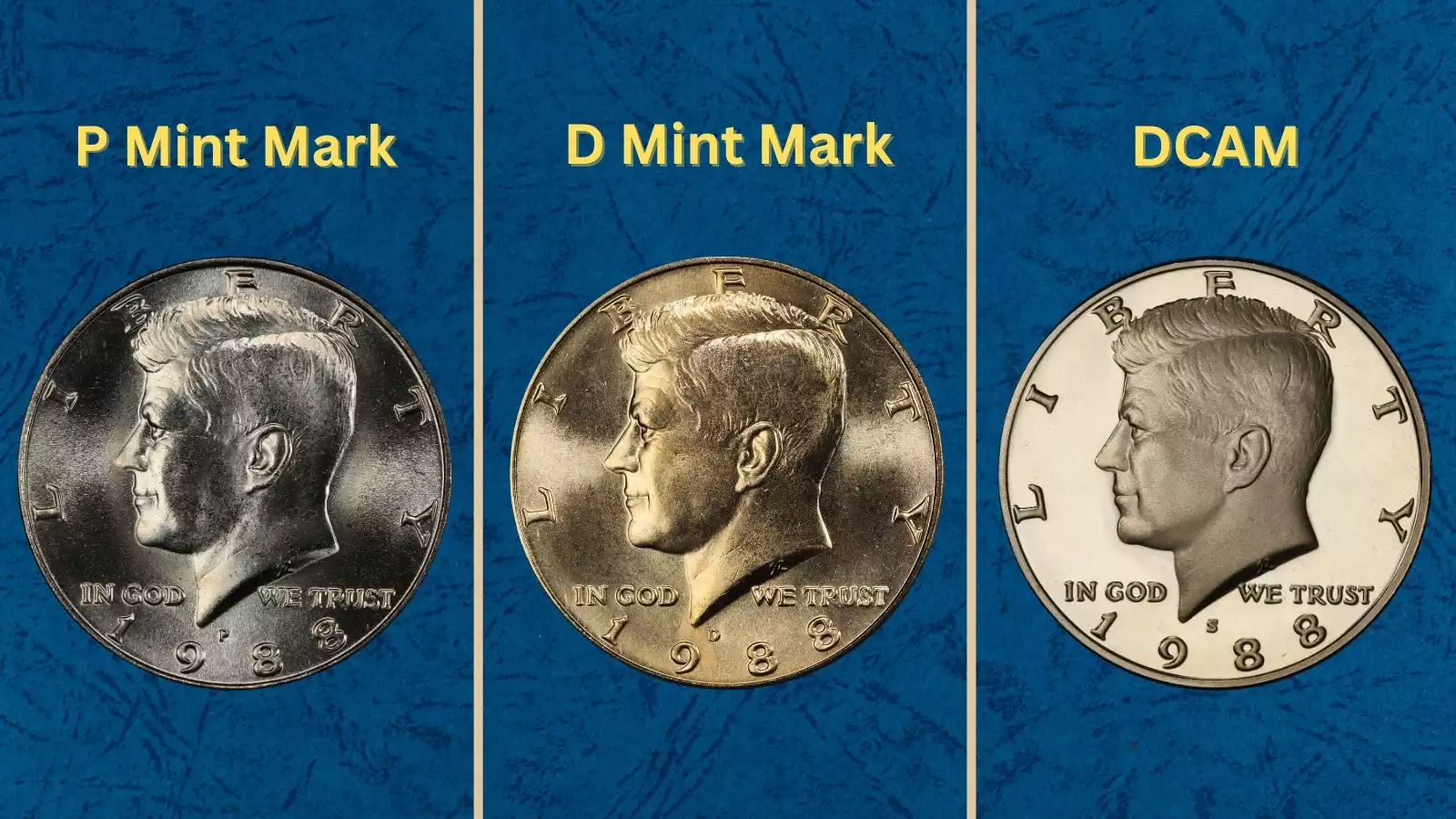
The mint mark is on the obverse (front) of the coin, just above the date. A 'P' indicates Philadelphia, 'D' indicates Denver, and 'S' indicates San Francisco (proof only). The letter sits above the '9' in the date 1988. If you see no mint mark at all on a business strike, that is unusual and worth investigating further with a professional numismatist.

What is the highest auction price ever paid for a 1988 half dollar?

The all-time auction record for any 1988 Kennedy half dollar is $3,680, paid for a perfect 1988-S PR70 Deep Cameo specimen at Heritage Auctions on September 1, 2003. Among business strikes, the record is $480 for a 1988-P graded MS-67 at Heritage Auctions in September 2019. The single 1988-D MS-68 coin (population of 1 at PCGS) carries a price guide value of approximately $4,500.

Is a 1988-S proof half dollar worth keeping?

Most 1988-S proofs in PR-68 and PR-69 DCAM grades are worth $10–$25 and are common. However, perfect PR-70 DCAM examples are worth more — typically $20–$55 at auction. The real prize is the 1988-S DDO FS-101 variety: if your proof shows hub doubling on LIBERTY or IN GOD WE TRUST under a 10× loupe, have it authenticated by PCGS or NGC immediately, as it could be worth $225–$1,150.

What does DCAM mean on a proof 1988 half dollar?

DCAM stands for Deep Cameo, awarded by PCGS and NGC to proof coins that show a strong, pronounced contrast between mirror-like background fields and heavily frosted raised design elements. It is the highest cameo designation available. A standard 1988-S proof without any cameo designation trades for just a few dollars, while a PR-70 DCAM specimen sold for $3,680 at Heritage Auctions. The DCAM designation significantly boosts a proof coin's value.

How many 1988 Kennedy half dollars were minted?

Three mint facilities produced 1988 Kennedy half dollars. The Philadelphia Mint struck 13,626,000 business strikes (1988-P). The Denver Mint produced 12,000,096 business strikes (1988-D). The San Francisco Mint produced 3,262,948 proof coins (1988-S) exclusively for collector proof sets. Combined, just under 29 million coins were struck — a relatively low total for the Kennedy series, particularly compared to years that topped 200 million.

Why do 1988 half dollars have bag marks?

Bag marks are small contact marks caused by coins striking each other during bulk storage and shipment in cloth mint bags. Because 1988 half dollars are large, heavy coins (11.30 grams), each collision leaves a more visible mark than on smaller denominations. Most 1988 business strikes were distributed in mint sets with minimal protection, compounding the problem. This contact damage is the primary reason why MS-67 and higher examples are genuine condition rarities worth significant premiums.

Should I clean my 1988 half dollar before selling it?

Never clean a coin before selling or grading it. Cleaning — even with mild soap — creates microscopic hairlines that ruin a coin's surface and can cause a PCGS or NGC grader to label it 'Cleaned' or 'Improperly Cleaned,' drastically reducing its value. An uncleaned 1988 half dollar with original mint luster will always sell for more than a cleaned example of the same grade. Leave the coin exactly as you found it and let professionals assess its condition.

Ready to Find Out What Your 1988 Half Dollar Is Worth?

Use the free calculator above — select your mint mark, condition, and any errors for an instant estimate based on real PCGS and Heritage auction data.

Run the Free Calculator →